Migolla: A Fun & Casual Script Handwritten Font for Makers
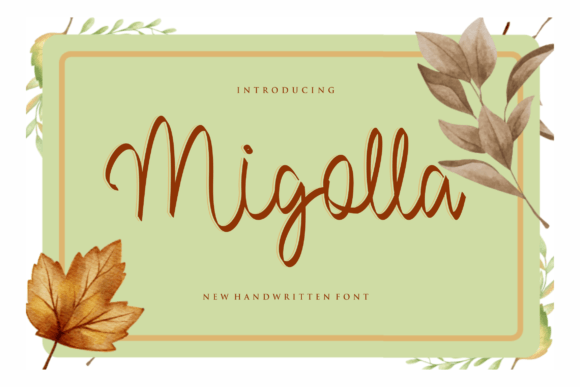
It started with a candle label—just me, my Cricut, and a blank white sticker sheet. I’d just restocked lavender-vanilla soy candles and needed something warm, personal, and unmistakably handmade. That’s when I opened my font library, scrolled past the stiff serifs and overused brush scripts, and landed on Migolla. Instantly, it felt like picking up a favorite pen—slightly bouncy, effortlessly friendly, full of quiet confidence. Migolla is a fun and casual handwritten script font, and in that first test cut, it wasn’t just legible—it was *inviting*. Like the label itself was smiling.
Migolla for Greeting Cards That Feel Like Handwritten Notes
When you’re designing greeting cards—birthday, thank-you, new baby, or just-because—you’re not just choosing type; you’re choosing tone. Migolla delivers that soft, approachable charm without tipping into cutesy or hard-to-read territory. As a Script Handwritten font, it mimics natural pen pressure and gentle flow, making each card feel like it came from your own notebook. I used it for “You’re My Person” on a kraft-fold card—paired with a clean sans serif (like Montserrat Light) for the date and return address—and the contrast gave warmth *and* clarity. For best results on printed cards: stick to titles and short phrases (under 6 words), avoid all-caps, and leave generous line spacing. Since Migolla is a single-weight Fonts file, it shines brightest at 24–60 pt—perfect for front-of-card impact, not body text.
Migolla for Candle Labels and Small Product Tags
Labels are tiny ambassadors. They need to be readable at a glance, cut cleanly on vinyl or sticker paper, and still carry your brand’s heart. Migolla works beautifully here—but only when sized right. At 14–18 pt on a 2" x 1" oval label, it reads clearly even under shop lighting. I tested it on matte black vinyl for “Sage & Sea Salt” candles and found the slight irregularity in letterforms added artisanal texture—not distraction. Pro tip: always run a test cut before batching. Because Migolla is a fun and casual handwritten script font, its subtle variations (like the slightly lifted ‘t’ crossbar or relaxed ‘g’ tail) give character, but they also mean tighter kerning on small cuts. If your cutting machine hesitates, loosen tracking by 10–15 units in Design Space or Silhouette Studio.
Migolla for Wedding Invitations and Elegant Branding
Yes—this playful Script Handwritten font belongs at weddings too. Not for every line, but for the *moments that matter*: names, dates, “Join Us,” or monogrammed initials. I designed a suite for a lakeside elopement using Migolla for the couple’s names atop ivory linen paper, then paired it with a delicate serif (Cormorant Garamond) for ceremony details. The result? Romantic, relaxed, and deeply personal—no cookie-cutter calligraphy vibes. Migolla doesn’t try to be formal, and that’s its strength. It says, “We’re celebrating *us*, not perfection.” Just remember: for legal names or addresses, lean on your pairing font. Let Migolla hold the emotional weight—not the logistics.
Migolla for Digital Printables and Planner Pages
As a printable creator, I use Migolla constantly—not as filler, but as focal point. On weekly planner headers (“Make It Count,” “Breathe Deeply”), it adds gentle intention without shouting. On wall art prints (“Good Things Take Time”), it turns a simple phrase into a quiet mantra. Because Migolla is a fun and casual handwritten script font, it avoids the stiffness of many commercial display fonts while staying crisp at 300 dpi. When exporting PDFs for Etsy, I embed the font and double-check that swashes or alternates (if included) render consistently across devices. Always verify licensing: this Fonts file supports commercial use, so you can sell the printables—not just use them personally.
Migolla for Boutique Packaging and Seasonal Tags
Last holiday season, I made mini kraft gift boxes for handmade bath salts. Each box got a hand-stamped tag—and instead of stamping by hand, I pre-designed tags in Canva using Migolla for “Merry & Bright” and “With Love.” Printed on recycled cardstock and tied with twine, they looked cohesive, joyful, and entirely handmade—even though they were batch-printed. Migolla’s rhythm feels human, not algorithmic, which makes seasonal items feel special, not mass-produced. For tags under 1.5", keep phrases to 2–3 words and avoid thin strokes near edges—its casual energy includes gentle thick-thin transitions, so very small sizes benefit from boldening in design software (just 5–10% extra stroke weight).
Migolla for Tote Bags, Mugs, and Shop Signage
I screen-printed “Hello, Sunshine” on organic cotton totes using Migolla as the sole type treatment—no icons, no extras. The font’s natural slant and open counters held up perfectly through ink bleed and wash testing. Same with ceramic mugs: the script’s generous spacing prevented smudging during sublimation. As a Script Handwritten font, Migolla thrives where personality matters more than precision. For signage (farmhouse-style wood signs, chalkboard menus, or storefront decals), it’s ideal for headlines up to 36". Just pair it with a sturdy sans serif for any supporting text—think “Est. 2022” or “Open Daily”—so hierarchy stays clear.
What to Check Before You Use Migolla Commercially
- Licensing: Confirm this Fonts file includes full commercial rights—yes, for physical goods, digital templates, SVG bundles, and merch.
- File Formats: Look for OTF and TTF—both work reliably in Cricut Design Space, Silhouette Studio, Canva, and Adobe apps.
- Extras: Some versions include stylistic alternates or ligatures. Test them early—they add polish, but aren’t essential for readability.
- Pairing: A neutral sans (like Poppins or Lato) balances Migolla’s energy. Avoid other scripts unless you’re intentionally layering textures.